Tuesday, October 18, 2016

CHARLOTTE BRONTE: An Independent Will: Review by Polly Guerin


Charlotte Bronte 1850 National Portrait Gallery
Charlotte Bronte,  a woman determined to succeed, declared herself "a free human being with an independent will." She was born in the era of The Cult of Domesticity on the desolate moors of Yorkshire, the daughter of an Anglican clergyman. 
   Charlotte and her sisters, and their brother, Branwell,  grew up blighted by domestic tragedy and loss and had to create a world of imagination for themselves. Save for the Parsonage cemetery at their doorstep and monotonous hours exploring the windswept expanses of the moors they were led as teenagers on a path of creative Juveniiia that resulted in plays and hand-made miniature books, illustrated with watercolor images. 
      For Charlotte and her sisters later it was Jane Eyre, Withering Heights, and Agnes Grey that gave the mid-nineteenth century a new concept of women in love and trying to live in society. 
Image Left: Life portrait of Charlotte Bronte, by George Richmond, on loan from London's National Portrait Gallery.
     CHARLOTTE BRONTE: An Independent Will, a new exhibit at The Morgan Library & Museum runs through January 2, 2017. It traces the writer's life from imaginative teenager to reluctant governess to published poet and masterful novelist. The exhibition celebrates the two-hundredth anniversary of Bronte's birth in 1816, and marks an historic collaboration between The Morgan, which holds one of the word's most important collections of Bronte Manuscripts and letters, and the Bronte Parsonage, in Haworth, England which lent a variety of key items including the author's earliest manuscript, her portable writing desk and paintbox, and a blue floral dress she wore in the 1850s.
Bronte's earliest surviving miniature manuscript book
THE MINUSCULE BOOKS Reading of the classics, the bible and Milton, Scott, and Lord Byron to name a few,  fueled the Bronte children's imagination and their games informed their writing, and enhanced their stories. The selection of Juvenilia presented in the exhibition highlights the whimsy and imaginativeness of the Brontes' production.  On one view is Charlotte's earliest surviving manuscript, a tiny handmade booklet. I observed, it is no more than two and a half inches by one and a fourth inches illustrated with watercolor drawings. It presents the story of a little girl named Anne who goes on an exciting journey. Best to use the magnifying glass provided in the exhibit hall to try to see the almost indecipherable writing. Bronte wrote it when she was about twelve. Image Right: Charlotte Bronte's story, beginning "There once was a little girl and her name was Anne ca 1828 Bronte Parsonage Museum.
TEACHING and PUBLISHING: In 1836, when she was nineteen, Bronte entered the Roe Head School where she previously had been a student, as a teacher, but chafed in her new role.  A few years later she took a a short-term position as a governess in a private home, caring for what she called the "riotous, perverse, unmanageable cubs."   Relief came with the largess of an aunt. Bronte and her sister Emily went to Brussels in 1842 to study and improve their teaching credentials.  It was there that she fell under the influence of her inspiring teacher, Constantin Heger and later suffered years of what appeared to be unrequited love for the married professor.  
Charlotte Bronte's gown circa 1850
      As Bronte biographer Rebecca Fraser wrote, "Working as governesses, teaching school, traveling to the continent, and caring for their volatile and tragic brother, Branwell, Charlotte and her sisters led difficult and fiery lives---lives that electrified their fiction, challenged the Victorian Age, and made them the most distinctive, enduring women---and novelists--of their time."
     In 1846, she and her sisters Emily and Anne self-published a book of poems, which by the record sold but one copy, yet was held in esteem by some of her followers. Jane Eyre, Wuthering Heights. and Agnes Grey followed. The authors retained the pseudonyms they had chosen for their book of poems the year earlier. Charlotte was Currier Bell, Emily, Elias Bell and Anne, Acton Bell.
 LEGACY:  Bronte published her last novel, Villette, in 1853. The following year, at the age of thirty-eight, she married Arthur Bell Nicholls, her father's curate. A mere nine months later, she died, most likely from complications of pregnancy.  Bronte's writing continues to have a profound impact on readers throughout the world, and many find her life story just as compelling as much of what lays within the stories parallel her extraordinary life's experiences. A woman who wrestled with her own independence. Charlotte Bronte's, An Independent Will Gallery Talk takes place Friday November 4 at 6 pm Free with museum admission. For further information about programs and the adult workshop visit 
www.themorgan.org  
      Ta Ta Darlings!!!  A reading group on Charlotte Bronte's final novel, Villette, in the historic family rooms of the nineteenth-century Morgan House,takes place on Nov. 1 and Dec. 13. Advance tickets are required. I'm going!!!  Polly loves to receive fan mail at pollytalknyc@gmail.com. Visit Polly's other Blogs at www.pollytalk.com and check the Blog that interests you listed in the left-hand column  

Monday, August 3, 2015

FANIA AND ZLATKA remembered in PAPER HEARTS by Meg Wiviott: Review by Polly Guerin

Meg Wiviott's young adult book PAPER HEARTS brings the story of Fania and Zlatka and their friendship through poetry written during the terrible days in Auschwitz The novel is is based on a true story of a bond that helped two teenage girls realize hope for the best in the face of the worst. The book of collected poems also focuses on twenty remarkable young women who conspired through their youth and determination to conspire against the Nazi regime, which classified them as subhuman, forced them to work as slave laborers, and thought of them as nothing more than the numbers tattooed on their arms---yet they conspired to commit an act of great defiance.
     They dared to behave as humans and they dared to celebrate life---a birthday---with a simple gesture that, if they have been caught, could have meant death. Needless to say, after some seventy years after the events, this story still resonates to remind us that courage and youthful optimism instilled a strong resolve in the hearts of these incarcerated young women.Through poetry in verse their plight in the hateful camp becomes a riveting story of fortitude and survival.
MAKING A BIRTHDAY CARD should seem like a simple everyday task but only "an act of defiance," a statement of hope makes this book such a treasure to read, to inspire, and to remind us of indomitable spirit of the youthful poets. Making a birthday card in Auschwitz was all of those things but death marches were real and the slightest effort of defiance was punishable by death.  Yet Zlatka had courage and the determination to create a birthday card for her best friend Fania. She stole and bartered for paper and scissors, and secretly created an origami heart. It was passed along the work tables to sign, which they did with their hopes to find love and happiness but most of all, freedom. It is not known how many of the girls who signed the Heart survived the death marches but  Fania  treasured her gift and kept it secret during her imprisonment, even carried it through the death marches. She kept the Heart with her when she was liberated, and through the years as she rebuilt her life and her family.
 
Meg Wiviott
This remarkable story lives on in the Montreal Holocaust Memorial Centre, where it is a permanent exhibition, telling its story of defiance, love, and friendship. Thousands of visitors who visit the Centre each year, will no doubt take to their own hearts this remarkable story in verse. Fania eventually returned to Poland, met her husband, and then settled later in Toronto, Canada, where they raised their daughter and son. Fania still lives there today.As for Zlatka, the creator of the Heart, she too returned to Poland, fell in love, got married and moved to Buenos Aires, Argentina, where she still loves today (as of October 2013).
   This is Meg Wiviott's first novel for young adults. Published by Margaret K. McElderry Books, an imprint of Simon & Schuster Children's Publishing, 1230 Avenue of the Americas, New York, NY 10020. On sale: 9/1/15
   Fan mail and comments about this review welcome at
pollytalknyc@gmail.com.,


Wednesday, March 18, 2015

INCOMPARABLE COUPLES By Rose Hartman Reviewed by Polly Guerin

Reading Rose Hartman's new book, Incomparable Couples, is like taking a trip down memory lane revisiting the glamorous and celebrated personalities who defined the fashion and social trendsetter era for three decades. The book is populated by people we knew and people we wish we knew. Nostalgia tugs at our hearts as we review the pages of engaging couples at the prime of their celebrity.
   Couples featured in this full-color, beautiful tome include:: Jerry Hall and Annie Leibovitz, Bob Mackie and Cher, Jean Paul Gautier and Lauren Bacall, Peter and Jane Fonda, Bianca and Jade Jagger, Sean Lennon and Yoko Ono, Liz Taylor and her dog, Robert Wolders and Audrey Hepburn, Whitney Houston and Bobby Brown, and 150 more, too numerous to list here.
    So why should we want to read Incomparable Couples?" The answer comes clear and forthright in the  photographs themselves and I can surreptitiously hear the reader saying, "Oh I remember them, and then repeat page after page, I remember them again, and then sigh. At best Hartman's photographic documentary serves as a permanent archival book referencing artists and muses, designers and muses, family, mothers and children; pets, friendships, models, marriages --images of people we remember and people we wish we had known.
   Hartman, the quintessential photographer of our time, captures beautiful duos, unlikely duos and some downright scary duos. Rose's images are always spontaneous, never staged, that is what makes these photographs so interesting and spellbinding.. Ms. Hartman tips the shutter at just the right moment, capturing a critical moment in a conversation--a pose, a gesture--to present a story abut two people from the world of popular culture.
  Eric Shiner who wrote some of the text wrote, "It might be best to think about Rose as an anthropologist who has spend so much time with her subjects that she has become a trusted, known entity."
   In her presence, celebrities have let their guard down, allowing her to capture moments otherwise rarely   seen. The vitality of the images in "Incomparable Couples" attest to the rare sense of familiarity.  Hartman portrays the humanity in her subjects. instead of their more famous, fashionable shells. :
  Incomparable Couples is published by ACC Editions,  photographs by Rose Hartman, Texts by Eric Shiner, Michael Gross and Rose Hartman, hardcover $49.50 available a fine book stores.
   Who is Rose Hartman? Rose stands as one of the most prolific photographers of our age. As a woman
photographer, she has jumped over every hurdle in a male-dominated world to create a huge body of work documenting the demimonde of fame and glamor in the center of the world of culture. Hartman is a one of those remarkable women who have scaled the heights of success in their oeuvre. She has created a book that has archival value, recording over time, she straddles the boundaries between street photography, portraiture and documentary photography. My hearty congratulations to Rose Hartman for preserving a world of celebrity for generations to come. As Eric Shiner, Director of the Any Warhol Museum said, "It takes two to tango, but it takes Rose to truly dance."
Read this feature on pollytalkfromnewyork.blogspot and also on amazingartdecodivas.blogspot (womendetermined to succeed) or go to www.pollytalk.com and click on the link in the left hand column to either one of these blogs.
 
 
   .

Monday, October 27, 2014

HELENA RUBINSTEIN: BEAUTY IN THE EYE OF THE BEHOLDER (c) By Polly Guerin

Helena Rubinstein may not be a household name, but the legendary magnate built a cosmetic empire and crowned herself Queen of her domain, reigning over the beauty routines of women worldwide for decades. Her story is one of inspiration for all women who aspire to ascend the ladder to success. What it took was a passion for living, a drive extraordinary and perseverance to succeed. And, it is about time that recognition be given to this pioneering woman who made her beauty business one of the hallmarks of the cosmetic industry.
   The Jewish Museum exhibit, Helena Rubinstein: Beauty is Power, through March 22, 2015 is the first museum exhibition to focus on the innovative cosmetics entrepreneur and art collector.. By the time of her death, Rubinstein had risen from her humble origins in a small town Jewish Poland to become a global icon of female entrepreneurship and a leader in art, fashion, design and philanthropy.  As head of a cosmetic empire that extended across four continents, she was, arguably, the first modern self-made woman magnate.
   Rubinstein was born in a small town in Poland in 1872. In 1888, when she was sixteen Rubinstein fled the prospect of an arranged marriage and found her way from Krakow to Vienna to Australia, where she established her first business, Helena Rubinstein & Co., producing skin creams; and at the same time she married her first husband, Edward Titus.
   Her talent for business and its inherent feminism reflects her modern thinking. One of the first slogans Rubinstein used to promote her cosmetics, "Beauty is Power," is an advertisement that first appeared in an Australian newspaper in 1904. This was revolutionary at the turn of the century when the use of cosmetics, associated with the painted faces of actresses and prostitutes, was widely frowned upon by the middle class, but Rubinstein found the means for ordinary women to transform themselves.  Her business challenged the myth of beauty and taste as inborn, or something to which on the wealthy were entitled. By encouraging women to define themselves as sell-expressive individuals, Rubinstein contributed to their empowerment.
She eventually returned to Europe where she established salons in the grandest districts of London and Paris, and also began collecting African and Oceanic art in 1909.
The Salon Format Inspired by the tradition of European literary salons, Rubinstein conceived of her beauty salons as intimate environments where progressive ideas were exchanged under the guidance of a sophisticated patroness. At the outbreak of World War I she moved to the United States, where she founded her first salon in 1915.  Today the term 'beauty salon" means a hairdresser or a day spa. But Rubinstein salon was a place designed entirely by women, where a client could learn not only how to improve her looks, but also how to re-conceive her standards of taste, to understand design, color, and art in order to express her own personality. What Rubinstein advocated was new and profound in the early 20th century. She offered women the ideal of self-invention, a fundamental principle of modernity.
The Art Collection Madame (as she was universally known) ruled with a firm hand and empowered
women. Case in point, at a huge rally in 1911 some women suffragists wore lip rouge as a badge of emancipation.
   Selections from Rubinstein's famous art collection include works by Pablo Picasso, Elie Nadelman, Frida Kahlo, Max Ernst, Leonor Fini, Joan Miro and Henri Matisse, among others, as well as thirty works from
her collection of African and Oceanic art. When people found it strange that a woman who had dedicated her life to beauty would purchase such "ugly things," Rubinstein said, "I had always favored the unusual and when I followed sound advice, as well as my own 'inner eye;'  my purchases were invariably good.":
   Other highlights include Rubinstein's beloved miniature period rooms, jewelry, and clothing designed by Cristobal Balenciaga, Elsa Schiaparelli and Paul Poiret. Her savvy for self-promotion is evident in portraits of her made by the leading artists of her day, from Marie Laurencin to Any Warhol.  Most interesting are the vintage advetisements, cosmetics products and professional films related to her beauty business.
At The Jewish Museum, located on Museum Mile at Fifth Avenue and 92nd Street,  www.thejm.org.
Ta Ta Darlings!!! Madame is my inspiration, she really set the independent mark for women. Fan mail welcome at pollytalknyc@gmail.com. Visit Polly's Blogs on www.pollytalk.com and in the left hand column click on the Blog of your interest be it amazing women, visionary men, treasures in New York or poetry.

Monday, August 19, 2013

ENERGETIC BLISS with SHARON BYKERK-LONERGAN By Polly Guerin

In a world filled with the cacophony of city life, the stress of work or personal health concerns it is comforting to know that women seeking the resurgence of  harmony in their lifestyle need go no further but turn to Sharon’s Energetic Bliss.  Her mission statement says it all. “My belief in the healing arts is deeply profound, providing an Energetic “whole” – istic approach.  I pledge to keep the power of gentle professional touch alive by providing an important service to women that can truly improve their quality of life by being the conduit, for their own self-healing.”  Sharon is a woman determined to succeed in holistic healing with a subtle approach that underscores the philosophy of Energetic Bliss.


HOLISTIC HEALING Sharon has dedicated her life to the well being of others. She is a woman whose hands have a distinct therapeutic touch that is gentle, yet goes deep into sensitizing where a client’s energy centers need the most attention and revitalization.  With soft persuasive hands, Sharon‘s gentle professional touch serves as a conduit that also helps women to heal themselves and clear toxins whether emotional, chemical or both. Her services are tuned into the needs of the individual and her uncanny ability to immediately attune to a client’s concerns makes her a truly sensitive practitioner.
THE SERVICES Sharon practices in disciplines including Reiki, Aromatherapy Massage, Hot Stone Massage, Polarity Therapy and Onnetsu Far Infrared Therapy. The wall in her salon attests to the fact that Sharon has honed her skills and authenticated her diverse practice. The serene salon has a skyline view with windows opening to the sunlight. A warm bed-like massage table, on which a client reclines, in a fully clothed session, provides a soothing experience that calms and restores disharmony in the energy fields of the body.  You can almost feel the tension and the burden of everyday concerns melt away. 
POLARITY THERAPY I can attest to the Polarity Therapy treatment as I was fortunate recently to experience it.  Sharon’s featherlike touch scanned my body reaching blocked currents in the body’s energy field, and at one place in particular, she touched a spot that dramatically resonated to her touch with a gentle but almost electrifying reaction.  I assessed this to mean that there may be severe blocking of energy in that area as well in other places. After the session I felt light and euphoric. I now realize that the power of gentle professional touch can truly improve the quality of life by clearing and balancing chakra/energy centers, relieve pain, activate the body’s natural ability to heal itself, relieve stress and release toxins or impurities, to name a few.
ENERGETIC BLISS, Natural Health Care for Women, focuses on your total well-being in treatments that soothe your senses, restore your body and replenish your spirit. Energetic Bliss is located at 121 Newark Ave., Suite 402, Downtown Jersey City, NJ 07302. Tel. 971.239.8476 or sharon@energetic bliss.com By appointment only. Visit her Web Site at www.energeticbliss.com

Thursday, May 30, 2013

GUERIN, POLLY's Illustrated Lecture on her book: COOPER-HEWITT DYNASTY OF NEW YORK

NYPL:  NEW YORK PUBLIC LIBRARY


M i d - M a n h a t t a n
40th Street and 5th Avenue
New York, NY 10016
212-340-0837

Thursday, June 27th, 2013
6:30 p.m. on the 6th floor

w e l c o m e s
Polly Guérin
presenting an illustrated lecture on her book
THE COOPER-HEWITT DYNASTY OF NEW YORK


About the presenter:
Polly Guérin
is a former adjunct professor at the Fashion Institute of Technology in New York
and the author of four college textbooks, four blogs,magazine articles and pollytalk columns.
Her featureson the decorative arts, antiques, collectibles and design have appeared in Art & Antiques magazine. She is alsotheauthor of four blogs: pollytalkfromnewyork;menremarkablevisionaries; womendeterminedtosucceed and poetryfromtheheartbypollyguerin.

Monday, May 13, 2013

PALMER, POTTER: Retail Pioneer and Bertha Honore (c) by Polly Guerin

womendeterminedtosucceed.blogspot
While retail theater on television is currently celebrating the rise of the department store, viewers would be served better to know that the true story of the man you brought retailing to the pinnacle of showmanship was Potter Palmer. He was the creator of what we now know as the modern department store. (It was not Marshall Field or Harry Selfridge) Palmer ranks highest among the remarkable visionaries who made shopping an adventure and entertainment destination.    However, he was more than just a merchant king he also gave Chicago, the grand Palmer House Hotel and many other ‘firsts’  including  introducing impressionism to the United States. Palmer's wife, Bertha Honore, shares in the limelight by becoming one of Chicago's most distinguished leaders for women's rights.   RETAIL ORIGINS Palmer invented many of the retail practices we take for granted today. He was the first captain of the merchant class to allow women to exchange merchandise.  He created the motto, “the customer is always right,” originated a liberal credit policy, opened the bargain basement concept and last but not least installed dazzling window displays. Obviously Palmer influenced other retailers who adopted his successful retail innovations. A man ahead of his time, Palmer hired one of the first female architects to construct a building for the World’s Columbia Exposition in 1892.                                                                                                                 LOVE UNDER FIRE Such a story is worth  historical reverence and to this end Corn Bred Films has set the record straight about  the lives of Bertha and Potter Palmer, one of the first and foremost power couples in the United States. Corn Bred's new 30 minute documentary film, LOVE UNDER FIRE, tells the epic love story between young socialite Bertha Honore and Potter Palmer, a self-made man twenty years her senior. Their passion for Chicago, the city they loved is a riveting saga that reveals more than meets the eye.                                                                           
PALMER ARRIVES Potter Palmer came from upstate New York and was interested in retailing.  He stopped off in Chicago a burgeoning Midwest town with mud roads but a growing community. Palmer saw opportunity and decided he wanted to be part of the city and prospered in real estate and retailing. After reaching an elevated level of business and social recognition, when he was thirty-eight years old Palmer was worth millions of dollars, a fine catch to say the least. Due to Palmer’s social ascendancy, he was invited to dinner at the home of real estate maven, where Palmer met thirteen year old Bertha Honore, an event that would forever change his  life.                                                                                                              PALMER HOTEL Bertha Honore was a remarkable woman, determined to succeed and did so in more way than when years later she married Palmer. Palmer was a man of great gestures and he built the Palmer Hotel as a wedding present for his bride. During the raging fire that destroyed Chicago in 1875 and the Palmer Hotel, Bertha seemingly rose from the ashes, a woman of great fortitude. She was the first woman to appear before Congress to petition the government for funds, and traveled throughout Europe, influencing royalty and industrialists. Palmer let Bertha shine in the limelight. She continued to be a great supporter of women’s education, wages and working conditions. This powerful couple’s story is breathtaking and illuminating as to how two people forged a legacy that makes the Palmers important figures in the historic record of our country’s evolution as a great retail empire.
TO ENJOY THIS REMARKABLE STORY OF THE PALMERS AND TO PURCHASE A COPY OF THE DVD, LOVE UNDER FIRE, CONTACT www.courtingbertha.com Or call 708.359.2783,

Sunday, May 5, 2013

HAUSMAN, KATHRYN: Design Pioneer, ADSNY (c) By Polly Guerin

Kathryn Hausman (Photo: Zenith Richards)
There are women born with many gifts and then there is Kathryn Hausman, a woman determined to succeed beyond any obstacles in her path, a woman who went past the glass ceiling and scaled to the heights of success in every field she endeavored.  How shall we define a woman of such diverse talents: mother, designer, entrepreneur of Medusa’S Heirlooms, collector and philanthropist, president of the Art Deco Society of  New York and glamour icon!!!  Hausman manages to toss all her responsibilities in the air and produce a legacy of achievement that is befitting a modern woman.  No, not one who came into her success through marriage or inheritance but through personal perseverance and persistence. Hausman was determined to succeed and to make the world a better place. She pursued her dreams and leaves a legacy to inspire other women to pursue their dreams as she did.     
MEDUSA’S HEIRLOOMS I remember meeting Kathryn many years ago when I was an accessories editor and found the starling creator introducing her hair ornaments and delightful accessories someplace on Third Avenue. And then I followed her to Bloomingdale's where sales were booming and another story was in the works. Striving and surviving throughout the decades and gaining momentum she built a thriving business and still has a big following nationwide, and Bendel’s is her best New York Customer. In her showroom at 385 Fifth Avenue baskets of hair ornaments, barrettes and jeweled accessories spill out from floor to ceiling and sparkle like diamonds, in a treasure trove display where buyers stepping into the magic kingdom descend to place orders of hair accessories for their boutiques and stores. 
SOUND INVESTMENT Hausman, a single divorced and devoted mother of two sons, invested in her family with unwavering devotion and to this end she said, "With the financial success of Medusa's Heirlooms I did something smart and bought a brownstone on East 89th street for $155,000 in 1978. If one is invited to this amazing home/museum there you will find Hausman's Goldscheider collection of ceramics made in Vienna from 1885 to 1938--gaily painted female figures from the 1920s that depict Hollywood actresses and exotic dancers. So rare and wonderful is the collection that its celebrity was presented  in an exhibition “Goldscheider Ceramics---A World Brand from Vienna” at the Leo Baeck Institute, part of the Center for Jewish History at 15 West 16 Street in 2009. In the future Hausman plans to document her Goldscheider collection in a book that no doubt will have profound collectible value.     
A COLLECTOR'S DEN That’s not all that is housed at Hausman’ s brownstone, in her personal collection drawers spill forth with Bakelite jewelry and with so many other treasures in her Art Deco-inspired interior it is like visiting a petite museum. She is as decorative as her collections. “I always dress a little costomey,” says the iconic designer.  “I like vintage clothes or a bit of eccentricity.”  A loyal friend with unwavering faithfulness, Kathryn seems to have the ability to put other people’s interests and needs before her own, and to this end she has also mentored young students from the Fashion Institute of Technology who have the opportunity to learn the accessories business first hand in her Medusa's Heirlooms' showroom.         
ART DECO SOCIETY PRESIDENT Kathy Hausman has been involved in the Art Deco Society of New York for over thirty years. She says, “I joined the Board as a shy, young Deco advocate and served as a Board member for many years and later was elected to be the Social Director producing great parties and balls at prestigious private clubs and venues. When Bill Weber, who was president for years and my inspiration became ill I was elected vice president and in the following year, 1999 I was voted in as president.”  Hausman’s role became even more demanding and in 1997 she represented and attended the ICAD’s Congress in Los Angeles. She was so inspired that she proposed at the ICAD’s 2001 Congress in Tulsa, Oklahoma, an official offer to host ICAD’s Congress in New York City. The vote was unanimous!!! 
ICADS NEW YORK CONGRESS In 2005 drew 250 attendees from all over the world to experience New York’s Art Deco treasures.  Scholarly lectures, parties and historical New York venues were orchestrated by Hausman in places of extraordinary historical reverence. I remember the Australian contingent and never met friendlier and more enthusiastic attendees but there were many other Deco international friends and this congress set the stage that recognized Hausman as a born leader on the world stage.                                                                                       
DECO GOALS FULFILLED Dawning on the heels of her success and after serving as President of ADSNY, Art Deco Society of New York for over 15 years, Kathryn Hausman leaves a legacy of achievement that cannot be matched by many other women.  As she said, “I am not leaving! I will sail perpetually on the ADSNY ship, but will no longer be at the helm.” Hausman’s Medusa’s Heirlooms continues to be one of New York’s eminent accessories firms. The Art Deco Society of New York, on the other hand, will never be the same, for under Hausman’s administration the organization was imbued with heightened awareness of the Art Deco significance of New York’s treasures and the events were always a sensation, a rare opportunity of expand one’s appreciation of Art Deco.
THANK YOU KATHRYN HAUSMAN, A MODERN WOMAN DETERMINED TO SUCCEED WHO RAISED THE LEVEL OF ART DECO APPRECIATION. SHE LEAVES A LEGACY OF CONSIDERABLE ACHIEVEMENT THAT HAS INSPIRED AND ENRICHED THE LIVES OF SO MAY DECO ENTHUSIASTS.

Sunday, January 6, 2013

AUSTEN, ALICE: Legendary Photographer (c) By Polly Guerin

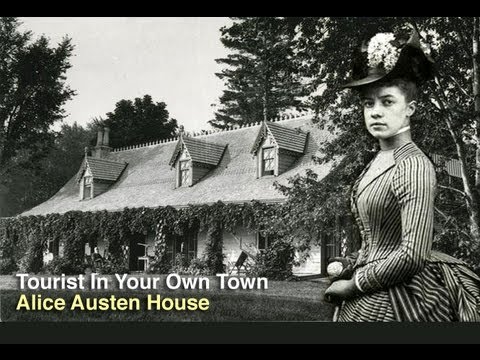
Alice Austen’s white cottage still stands at the water’s edge in the neighborhood of Clifton on Staten Island--- a testament to Alice’s long and remarkable life as a photographer. Born into comfortable circumstances Alice had no need to pursue a career, but photography, that started out as perhaps a hobby, became her passion. A young woman determined to succeed; Alice deserves her due recognition as a pioneer in this genre. 
FIRST LADY OF THE LENS She was one of America’s earliest and most prolific female photographers and over the course of her life created 8000 images. For one thing in the late nineteenth century, cameras were a cumbersome affair, but Alice surpassed any restraints and managed to carve a niche in the photography world with images that preserve a myriad of subjects. She captured the great transatlantic ships that still pass in front of her house, the coming of the automobile to the beginning of tennis, the countryside and world beyond. The Alice Austen House Museum, Clear Comfort, is located at 2 Hylan Blvd., Staten Island, New York.
FROM SOCIETY BELLE TO PHOTOGRAPHER It was her Danish Uncle Oswald who brought home a camera in 1876 and her Uncle Peter who showed her how to develop the negative images on the dry plates she exposed. Alice was captivated by the new art form and advanced forward with alacrity. However, Alice always insisted, that except for these initial demonstrations, she simply “learned by doing.” By the time she was eighteen, Alice was a professional photographer and her family was sufficiently comfortable to indulge Alice in the best of the cumbersome equipment she required. A closet on the second floor was converted into Alice’s darkroom. Ships sailing the Narrows were her favorite photographic subject---over the years she saw and recorded them all---racing yachts, schooners, tugs, warships, luxury liners and immigrant ships from the vantage point of Clear Comfort, a Victorian Gothic cottage on the shores of the Verrazano Narrows.
LAUNCHING A NEW CAREER Most belles during Alice’s time would not have taken on such a demanding task as photography was not a lighthearted affair. Wearing her Sunday best, a bustle fashion gown with striped over skirt one can only imagine how difficult it may have been to photograph the fine old houses and historic buildings on the island. It was not an easy adventure--at the same time lugging around fifty pounds of photographic equipment. She hauled her camera and tripod along to picnics, masquerades and chronicled the social life of musical evenings in her friends’ parlors as well as family gatherings and weddings. She even climbed a fence post, not caring if she exposed her ankles, in pursuit of the picture she wanted of local auto speed trials.
POSING HER SUBJECTS Alice would go to almost any length of get the picture she wanted. She was rather a perfectionist and she did not care how impatient her complaining subjects became. The expression of her subjects and the overall composition had to be just right and the exposure in the right light. She enjoyed recording Americans at work, boat races, amusement parks, country fairs in Vermont and the great world fairs in Chicago and Buffalo. She may have spent more than twenty summers aboard and always traveled off the beaten path to capture the activities in some tiny town and she felt equally free to visit places considered unseemly for a lady. Alice usually traveled with two cameras capable of producing images of different proportions, which filled a large steamer trunk. It was a cumbersome affair but Alice was a strong woman capable of carrying her heavy equipment creating in her lifetime images with lasting beauty that chronicle a legacy from America’s past.
     Alice Austen used her camera in a very personal way to record people, places and interesting travels. Her photographs show us real people and places as they actually appeared and we are made luckier by the fact that she captured these images of a wonderful time in America’s history. I suggest that you also read:: ALICE’S WORLD, The Life and Photography of an American Original: Alice Austen, 1866-1952 by Ann Novotny, Chatham Press, Old Greenwich, Connecticut.
   Polly loves to hear from her readers, please send your comments to pollytalknyc@gmail.com.

Thursday, December 6, 2012

GREEN, HETTY: THE EMPRESS OF FINANCE (c) By Polly Guerin

Henrietta Howland Robinson, known as Hetty Green, beat the robber barons at their own game; invested her dowry in bonds rather than in a husband and was the first woman to make a substantial impact on Wall Street. Why should we be interested in Hetty? Because this feisty Victorian , despite stiff competition of the mostly male business environment, paved the way for women to think differently about their circumstances. Hetty was known for her financial prowess and ability to parlay her wealth through shrewdly investing in the stock market and made a fortune on wall street. Hetty Geeen was an American woman determined to succeed and this in itself is a remarkable feat that she achieved in the Gilded Age.
MARRIAGE AND INVESTING Hetty wasn’t expected to do anything particular but to marry and bring in capital that would then be managed by a male, family member. It was the era when women did not have control of their finances or inheritance. Hetty would shun such an idea and set her path of independence from the start. As was the custom when time came for marriage, her parents handed Hetty $l,200 for gowns and carriages and sent her off to the nation’s financial capital to attract a spouse. Nothing doing, Hetty invested $l, 000 of that money in bonds and from then on she was on a roll, caught up in the web of investing.
GREEN’S HERITAGE Hetty was born, Henrietta Howland Robinson in 1834-1916, and her family was wealthy merchants owning vast fleets of whaling ships in New Bedford, MA. Early on Henrietta (Hetty) cleaved to her father and from the age of six she was reading financial newspapers to him and this is how she learned about stocks and bonds; by thirteen Hetty became the family bookkeeper. At the age of 33, Hetty married Edward Henry Green, a member of a wealthy Vermont family. Ahead of her time, she made him renounce all rights to her money before the wedding on July 11, 1867. The young couple moved to London and there raised a son, Edward Howland Robinson ‘Ned’ Green and daughter Hetty Sylvia Ann Howland Green. When her father died in 1864, Hetty inherited $7.5 million and started a legal campaign to get access to the money she inherited. Against the objections of most of her family , she invested in Civil War bonds.
A SUCCESSFUL BUSINESS WOMAN When the family returned to New York City Hetty began parlaying her inheritances into her own astonishing fortune. She conducted much of her business at the offices of the Seaboard National Bank in order to avoid paying rent elsewhere and this begins a routine of stinginess and denial when she could easily have afforded all the luxuries that her wealth could afford.. She could be seen in the financial arenas of business wearing her unusually dour dress, which was mostly black and which she rarely cleaned as it being too expensive to do so, and this formidable appearance she was nicknamed, “The Witch of Wall Street.” Surrounded by her trunks and papers she ate frugally. Yet she was a successful business woman who dealt mainly in real estate, invested in railroads, and lent money. It is legendary that on several occasions the city o f New York came to Hetty in need of loans, particularly during the Panic of 1907 when she wrote a check for $l.l million.
DENIAL TO THE END Sadly, Hetty’s stinginess carried over to the welfare of her children. When her son Ned broke his leg she denied him immediate professional medical attention deeming it too expensive and held back her daughter from marriage because she disapproved of all over Sylvia’s suitors because she suspected they wanted to get their hands on her money. When her children left home Hetty moved repeatedly to small apartments in different boroughs, mainly to avoid tax officials in any state. She failed in the great arena of philanthropy as parting with money was at the hallmark of her stinginess. So fearful was she of parting with money that she did not underwrite the great institutions, libraries or hospitals of the era. When it came to finance Hetty was a genius; yet she led a life of extreme thrift.

In Janet Wallach’s book, The Richest Woman in America, Doubleday she says that Hetty was a talented investor who had the bad luck to be born in an era when the guild of Victorian men, shut out a whole class of minds---women’s. Fortunately, not so today, women have scaled the heights of management and proving their mettle and breaking new ground in the financial world.

Wednesday, November 28, 2012

GILBRETH, LILLIAN: Mother of Modern Management (c) By Polly Guerin

One would hardly have expected Lillian Evelyn Moller Gilbreth (1878-1972), an American psychologist and industrial engineer to be one of the first superwomen who combined career and home life. Despite the fact that her father was not an advocate of higher education for women, she was determined to succeed and managed to graduate from the University of California in 1900 and pursued her master’s degree at Columbia University, but illness forced a return to California; she went back to Berkeley and received a master’s degree in literature in 1902. She seemingly ‘had it all’ and was one of the first females working in the fields of engineering and industrial psychology. Lillian considered herself plain and never expected to get married but is perhaps best remembered as the mother of twelve children. The books Cheaper by the Dozen and Belles on Their Toes (written by their children Ernestine and Frank Jr.) were subsequently made into movies. Lillian Moller Gilbreth was a remarkable woman for her time and her work paved the way for other women to pursue similar industrial engineering careers.   
A SUMMER ROMANCE After graduating she celebrated by taking a trip to Europe and on a stopover in Boston the group’s chaperon Minnie Bunker introduced Lillian to her cousin Frank Bunker Gilbreth, a well-off construction company owner. It must have been love at first sight because they had an instant connection and upon her return from Europe Frank travelled to California to meet her family. They became engaged and married in 1904. Frank, who never went to college, was interested in efficiency in the workplace and together they began their study of scientific management principles and Lillian worked by his side in his consulting business. They began their family and moved to Rhode Island in 1910, where Lillian took her doctorate in psychology at Brown University in 1915 with four young children in tow at the ceremony.
TRUE PARTNERS Lillian and Frank were true partners at home and in business and applied their scientific management principles to the running of their household and the businesses to whom they consulted. Where Frank was concerned with the technical aspects of worker efficiency, Lillian was concerned with the human aspects of time management. Her work with Frank helped create job standardization, incentive wage-plans, and job simplification, and she was the first to recognize the effects of fatigue and stress on time management. Over seventeen years, the couple had twelve children all the while collaborating together. The story of their family life with their dozen children, in the fore-mentioned books, chronicles how they applied their interest in time and motion study to the organization and daily activities of such a large family.
LILLIAN’s RECOGNITION Lillian and Frank wrote several books together, but Lillian was never recognized as co-author because the publishers were concerned about the credibility of the books if it were known that a woman was one of its authors. Yet Lillian had a doctorate and Frank had not even attended a university, but Lillian was already gaining recognition as a pioneer of what is now known as organizational psychology. When Frank died of a heart attack in 1924, Lillian was faced was the enormous task of raising the children alone and finding a way to continue their consulting business. She returned to holding workshops in their home. She became the first woman member of the American Society of Mechanical Engineers and in 1935 she went to Purdue as a professor of management and the first professor in the engineering school. In her consulting business, she worked with GE and other firms to improve design of kitchens and household appliances. During the Great Depression she was asked by President Hoover to address unemployment and launched the successful “Share the Work” program.
THE RECIPIENT OF MORE THAN A DOZEN HONORARY DEGREES, LILLIAN MOLLER GILBRETH’S ABILITY TO COMBINE A CAREER AND FAMILY LED TO HER BEING CALLED, BY THE CALIFORNIA MONTHLY IN1944, “A Genius in the Art of Living.”

Tuesday, October 9, 2012

BATH, PATRICIA DOCTOR, BLACK INVENTOR

Imagine being born in the 1940s with the stresses associated with Harlem and World War II pending. One would not likely expect that a beautiful Black woman would emerge out of this chaos to become a renowned scientist. Notwithstanding obstacles the famous African-American inventor, Dr. Patricia Bath was a woman determined to succeed in an area of medicine where few women would have cared or been able to infiltrate. One of Dr. Bath’s finest achievements is the Laserphaco Probe which through cataract surgery gave people new vision. Kudos to you Dr. Bath, your brilliant mind inspires all women today to pursue their dream. OVERCOMING OBSTACLES Dr. Bath remembers, “Sexism, racism, and relative poverty were the obstacles which I faced as a young girl growing up in Harlem. There were no women physicians I knew of and surgery was a male-dominated profession, no high schools existed in Harlem, a predominately Black community; additionally Blacks were excluded from numerous medical schools and medical societies; and, my family did not possess the funds to send me to medical school.” However, her mother encouraged Patricia to read constantly and broadened her interest in science by buying her a chemistry set.
DEVELOPING LASERPHACO PROBE Image living in a world of hazy, cloudy vision that would result in total darkness? Before 1985 this was the plight of those with cataracts who did not want to risk surgery with a mechanical grinder. Doctor Bath’s passionate dedication to the treatment and prevention of blindness led her to develop the Cataract Laserphaco Probe; designed to use the power of a laser to quickly and painlessly vaporize cataracts from patients’ eyes.
FIRST AFRICAN AMERICAN FEMALE DOCTOR’S PATENT Dr. Bath a New York based ophthalmologist, was living in Los angles when she received her first patent in 1988, thus becoming the first African-American female doctor to patent a medical invention. Her patent was for removing cataract lenses transformed eye surgery making the procedure more accurate. The difference between the old method and her new invention was the difference between the use of highly accurate laser technology and the somewhat subjective accuracy of a mechanical device. With yet another invention Dr. Bath was able to restore sight to people who had been blind for over 30 years.
A MERIT AWARD Science was at the heart of her ambition form the start. Patricia served as editor of the Charles Evans Hughes High School science paper and was selected from a vast number of students from across the country for a summer program sponsored by the National Science Foundation. She was only 16 years old she worked in the field of cancer research and her mentor, Dr. Robert Bernard incorporated parts of her research into a joint scientific paper which he presented in Washington, D.C. Due to the resulting publicity, Mademoiselle Magazine presented Patricia with its 1960 Merit Award.
ACADEMIC ACHIEVER Further on Patricia graduated from Howard University School of Medicine in 1968. Her reputation as an acclaimed scientist was acknowledged in 1975, when Dr. Bath became the first African-American woman surgeon at the UCLA Medical Center and the first woman to be on the faculty of the UCLA Jules Stein Eye Institute. Need I say more? In her remarkable journey she founded and was the first president of the American Institute for the Prevention of Blindness.
DOCTOR PATRICIA BATH WAS ELECTED TO HUNTER COLLEGE HALL OF FAME IN 1988 AND ELECTED AS HOWARD UNIVERSITY PIONEER IN ACADEMIC MEDICINE IN 1993. WITH REVERENCE WE STAND IN AWE AND ADMIRATION FOR HER COURAGE AND INSPIRATION , AND DETERMINATION TO SUCCEED.

Tuesday, September 25, 2012

VON NESSEN, GRETA INDUSTRIAL DESIGNER (c) By Polly Guerin

Greta von Nessen may not be a household word today but when she created the Anywhere Lamp in 195l there was nothing like it, but at the same time, there was absolutely nothing new about it; all the lamp’s parts had been available as early as the 1920s. Amazing! She was an innovator, a style caster of a modern style. Greta decided instead of totally reinventing the wheel, to wield already-been made parts together (each from a different design periods) to create something new. Greta von Nessen was a woman determined to succeed in a man’s world where so few women had made their mark. In a sense her lamp was a game-changer-or at least parts the effort towards taking design to its next level.
WHAT IS INDUSTRIAL DESIGN? It emerged as a profession in the 1920s but took firmer hold in the depression the United States. After the stuffiness of previous eras manufacturers turned to industrial designers to give their products a modern look that would attract consumer appeal. It was a fresh new beginning and the timing was fortuitous. At a time when the country was at a low-ebb, the new streamlined works evoked a sense of speed and efficiency and projected the image of progress. At the same time, it allowed corporations to mass produce items and industrial designers lowered the costs by exploiting new materials like plastic, vinyl, chrome, aluminum creating works through molds and shaping. Resulting affordable prices and a growing prosperity helped to drive popular demand for modernism.
GRETA BEHIND HER MAN Greta was the widow of the industrial designer, Walter Von Nessen founder of Nessen Studios, established in 1927 in New York City, now Nessen Lamps Inc. Von Nessen was the only major designer to concentrate on innovative contemporary lighting and quickly gained a following with well known architects. After her husband’s death in 1943, Greta continued his lighting and furniture business developing designs of her own, particularly the Anywhere Lamp. She is counted among the pioneers in American industrial design and her designs have been featured at MOMA, the Modern Museum of Art and on a United States postage stamp. There seems to be very little biographical date about Great except that she was an American born in Sweden in 1900 and died in 1978.

GRETA VON NESSEN, ONE OF THE PIONEERS IN INDUSTRIAL DESIGN, SERVES AS INSPIRATION FOR WOMEN TODAY WHO WILL SET THE STANDARD FOR A NEW GENRE OF FUTURE MODERNISM.

Tuesday, September 11, 2012

JULIETTE 'DAISY' GORDON LOW GIRL SCOUT LEADER (c) By Polly Guerin

When I visited Savannah, Georgia I was delighted with the quaint neighborhoods with their English style gardens and Victorian houses, and in this unlikely place I discovered Juliette ‘Daisy’ Gordon Low, the daughter of a proper Southern family who gave girls a voice before the country even gave women the vote. On March 12, 1912 she established the Girl Scouts in Savannah and from a single troop of 18 girls; the Girl Scouts has grown to an international organization of 10 million members in 145 countries. On the occasion of the Girl Scouts of the USA, which celebrates its 100th anniversary in 2012, we pay tribute to “Daisy,” as everyone knew her, a woman determined to succeed, and did so at a time when it was unthinkable that an elite Southern girl would prepare for a career. Pictured left: Daisy pins an achievement award on one of her Girl Scouts. Inset: Daisy as a young Southern society debutante.
‘DAISY’ ON THE VERGE Daisy was the product of the genteel South and the daughter of a wealthy cotton broker, as cotton was King in Savannah her father was wealthy and could indulge his daughter. Very little was expected of her and she could have gone on her merry way after attending finishing school to engage in cultural pursuits, but most certainly her first priority was to land a husband. That’s exactly what daisy did, she feel hopelessly in love with William Mackay Low, called ‘Willy,’ the heir to a British fortune.
THE UPPER CRUST This fairytale romance culminated in stunning society marriage in Savannah in 1886. Tragedy began at the start when a piece of rice tossed at the newlyweds logged in Daisy’s ear and that exacerbated an already existing poor hearing problem. When a doctor attempting to remove the rice punctured her eardrum she lost most of her good hearing as well. A feisty woman, Daisy’s near deafness did not slow her down but the antics of the British upper class were her undoing. Her philandering husband drank to excess and he made no attempt to conceal his affair.
BREAKING AWAY When the Spanish-American War broke out in 1898 and the impending divorce, and the untimely demise of her husband, Daisy found herself a widow in her 40s, but she decided it is never too late to change your life. So she headed back to America determined and made life-changing decisions. As fate would have it, at a luncheon she met retired general Robert Baden-Powell, a hero of the second Boer War, who regaled her about his scouting program for the Boy Scouts. This encounter began a lifelong relationship with Powell and she caught the spirit of the message. So much so that using her personal fortune, her society contacts and her personal connection with Powell Daisy introduced Girl Guides to America.
SELF HELP BOOK Daisy was an innovator and she helped write and publish “How Girls Can Help Their Country,” a feminist self-help book before either term even existed. Eventually the Girl Guides name was changed to Girl Scouts but they do more than sell cookies: they teach respect, confidence, compassion and leadership. The philosophy or the organization and the activities and projects the girls participate in are the inspiration of its founder Juliette ‘Daisy’ Gordon Low. At first parents were reluctant to let their daughters join a group promoting independence, but relented when it became apparent that self-improvement far outweighed any thought of revolution. The Girl Scouts uniform gave the members of the troop a sense of true belonging to a new breed of young women who would pave the way for independence.

WE SALUTE JULIETTE ‘DAISY’ GORDON LOW; A WOMAN DETERMINED TO SUCCEED WHERE NO OTHER HAD VENTURED BEFORE CREATING THE GIRL SCOUTS OF AMERICAN A POWERFUL ICON FOR MILLIONS OF YOUNG WOMEN. TODAY THE GIRL SCOUTS HAS GROWN TO AN ORGANIZATION OF 3.3 MILLION ACTIVE MEMBERS, 50 MILLION ALUMNAE AND TROOPS IN 92 COUNTRIES.

Friday, August 10, 2012

CABRERA,GLORIA Cosmetologist the Natural Way(c) By Polly Guerin

Making clients beautiful has been the livelong ambition of Gloria Cabrera, a cosmetologist for over thirty years. A petite Philippine native, Gloria, honed her skills and after owning a successful salon in the Philippines, she had the serendipitous opportunity to come to New York City, where she was able to fulfill her dream of being a salon and spa owner. She is a woman determined to succeed and has plied her trade “A Natural Way of Beauty,” for over 30 years in the Gramercy Park area of New York City. Gloria is a success story that should serve as inspiration of other women who immigrate to the United States and wish to be business owners. Gloria did it through perseverance and the kind of hands-on ownership that makes customer service a very personal way of doing business.
SCIENCE AND NATURAL INGREDIENTS With the combination of science and natural Asian ingredients from herbs, plants, grains and flower oils, Gloria created a skin care line that revitalizes and helps the skin’s true beauty. Gloria says, “These ingredients not only improve the glow and texture of the skin, but also protects it from environmental damage and aging.” Now that’s the right approach to skin care. Clients who have used the Gloria Cabrera Whitening and Anti-Aging Facials and skincare products attest to their effectiveness, which have shown results in a week, leaving skin fresh and radiant. Most interesting to women with dark spots Gloria’s products lighten those spots and evens skin tone, and helps to reduce fine lines and wrinkles.
 FACIAL CLEANSERS I’ve always envied women who have that special glow and wondered how they maintained such a youthful appearance. This is a special concern of New York City women who are always trying to find ways to keep their skin clean and beautiful. For one thing, Gloria Cabrera products wash away all the debris, excess oil and free radicals that age the skin, and those natural ingredients help restore skin leaving it fresh and glowing. The Herbal Cleanser & Toner, for example, is made with natural ingredients, including rose petals and lavender buds, and smells just divine! It is designed to cleanse, tone, unclog pores and help prevent fine lines, leaving skin fresh and glowing. The organic Face Mask is another yummy mixture containing Almond Extract, lavender, Rose Power and Clay. You get the point, it’s beauty the natural way. FACE MOISTURIZERS/FIRMING CREAM Living in New York City puts a lot of stress on a woman’s face, and that why moisturizers are such an important part of a daily beauty routine. Why? Because moisturizers hydrate, restore and refresh dull skin, while protecting from sun and environmental pollution. No need for a facelift, try results the natural way. The Neroli Firming Cream in this product range is infused with hydrating mixture of neroli, lavender and other essential oils which help to eliminate fine lines, minimizes pores and most important, it leaves the skin firmer, smoother and glowing.
I HATE MY NECK, TOO!! What could be more delicious than a Ginger Rice Body Exfoliant? This combination of natural herbs and Himalayan salt creates a perfect blend that polishes away dry, dead skin and leaves the surface smooth and radiant. You remember the book “I Hate My Neck,” by the late Nora Ephron…well, I do, too, but Gloria suggests her non surgical anti-aging neck serum, a special blend of essential oils that helps prevent wrinkles, loss of skin elasticity and double chin, while preserving skin moisture for firm, smith skin. Need I say more? Visit Gloria Cabrera at 309 East 23rd St, NYC 212.689.6815. www.gloriacabrerany.com.